

Accounting for the Algorithm: Tracking ROI on AI-Powered Content Creation vs. Custom Development Costs
Reading Time: 7 minutesAs a marketing director or CMO, you’ve seen firsthand how AI has woven its way into most of the tools you use. And you’ve likely experimented with different AI workflows to streamline content operations.
But you’ve also probably noticed something else: AI costs aren’t as cheap as people think.
Let’s take a closer look at tracking the return on investment (ROI) on AI-powered content creation versus custom development costs. 👇
Debunking the main myth about AI versus human content creation costs
First and foremost, it’s kind of odd to think of this as an either/or scenario. AI content tools can’t self-operate. They need a human in the driver’s seat. That said, you can compare AI-assisted content versus non-AI-assisted content.
Some AI-assisted content tools and processes you’ve probably tried include:
- – Using AI-assisted CRM tools, like HubSpot or Salesforce, to help analyze metrics such as customer lifetime value, conversion rates, and click-throughs.
- – Adding Grammarly’s AI-assisted editing extension to your browser to auto-check for spelling or grammar errors.
- – Pulling semantic keywords with an SEO tool, like Frase or MarketMuse, with AI capabilities built in.
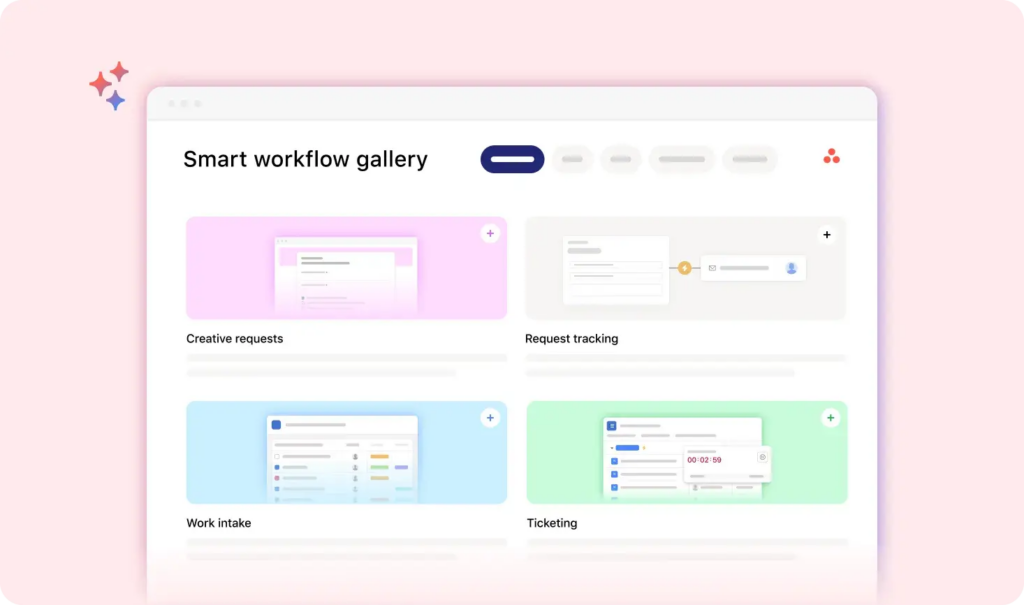
- – Creating AI-assisted content production workflows inside a project management tool.
- – Editing your content and checking for plagiarism with an AI-assisted editor, like Writer.
- – Experimenting with brainstorming, outlining, and repurposing content with ChatGPT.
- – Experimenting with Canva’s AI magic tools to create high-quality visuals.
- – Reading AI overviews when performing a quick Google search.
- – Using AI‑based scheduling for social media campaigns.
- – Researching data and pulling stats from Perplixity.
While all of these are super helpful and can reduce how much time you spend on content tasks, they still require:
- – Human post-editing processes
- – Human compliance reviewers
- – Human prompt engineering
- – Human quality controls
- – Human governance
- – Human reiteration
- – Human input
Plus, your monthly or annual subscription costs. (More on this below.)
TL;DR: It’s not AI versus humans. The real comparison is AI + humans versus humans working alone.
Costs of AI-assisted content creation
When you add AI to your content workflow, it feels cheap at first. A $20/month tool here. A prompt window there. Maybe a few token fees. No big deal, right?
Not exactly. Once you start using AI across campaigns, the price tag gets bigger, messier, and easier to overlook.
Here’s a clearer explanation of some ROI markers and what you’re paying for. 👇
The obvious subscription stuff
These are the tools you know you’re paying for. For example, your LLM subscription, your SEO tools, your project management tools with built-in AI, and your image generators.
They’re usually billed monthly or annually. But they get pretty expensive as you scale your marketing efforts and get forced into higher tiers. This is especially true if you use a tool like HubSpot for advanced customer journey tracking and conversion tracking.
You might also have to factor in AI app development costs if you need to build a custom app for your marketing agency. Some agencies build their own apps or analytics dashboards for their clients. (This automates pulling data from CRMs, analytics, and ad platforms to create custom reports for their customers.)
Compliance, legal, and brand safety
AI loves to guess. Which means you’re paying for humans to catch hallucinations, copyright issues, risky claims, and anything that might upset legal or break your brand guidelines.
If you don’t add these governance costs into your ROI tracking, your numbers will lie to you.
This may look like having a quality control team or outsourcing your fact-checking to advisors. (Especially important if you create legal or medical content.)
Marketing automation platform workflow overhead
Your AI doesn’t magically plug into your CMS, CRM systems, social schedulers, or analytics tools. Someone has to set up automations, maintain them, fix breakage, update tracking code, and keep everything moving.
Not to mention setting up conversion-tracking workflows and running analytics for KPIs.
This is your “ops tax,” and it’s very real. 🙃
Data cleanup and prep
AI doesn’t work well with messy inputs.
If you’re feeding it customer research, product info, or CRM data to personalize content, someone has to clean and structure that data. And if you’re targeting lots of marketing channels, the work multiplies.
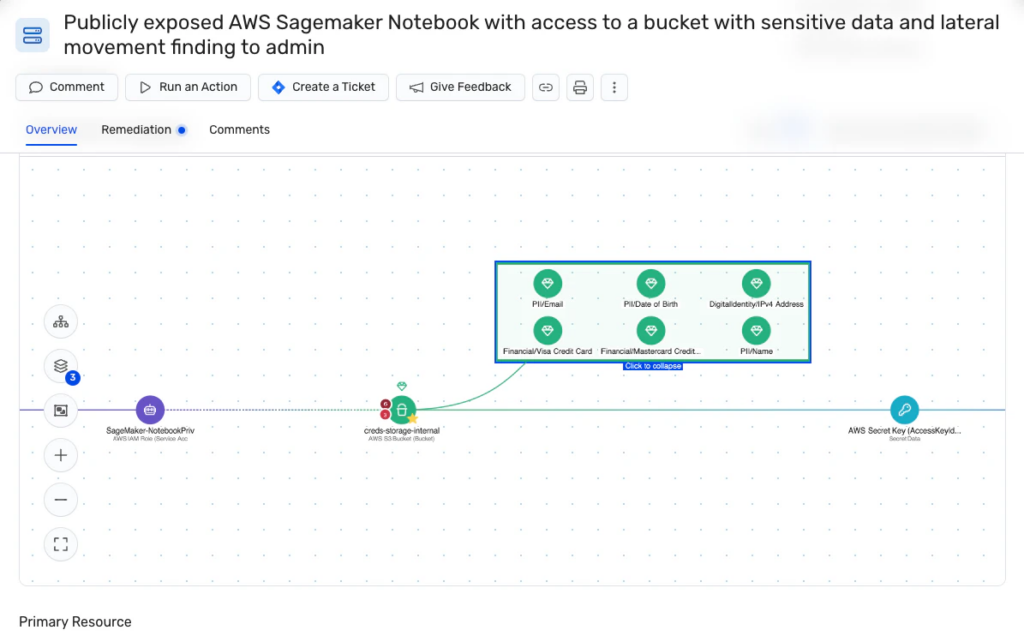
When looking into AI-powered data tools, it’s also important to take AI security into consideration, since they open up your infrastructure to new vulnerabilities. Vulnerability scanners and other tools add to your costs. (But they’re often worth it!)
Model drift and content refresh
Facts expire, and brand voice evolves. Your AI workflows need tuning, new prompts, updated guardrails, and sometimes entire rebuilds to keep up with the changes.
This is ongoing, and most teams forget to budget for it.
Ads and marketing effectiveness: The cost of producing “more”
AI can crank out an advertising campaign or blog content fast, but volume isn’t value. If your landing page click-through rate, conversion rate, or revenue per page drops even a little, your ROI tanks.
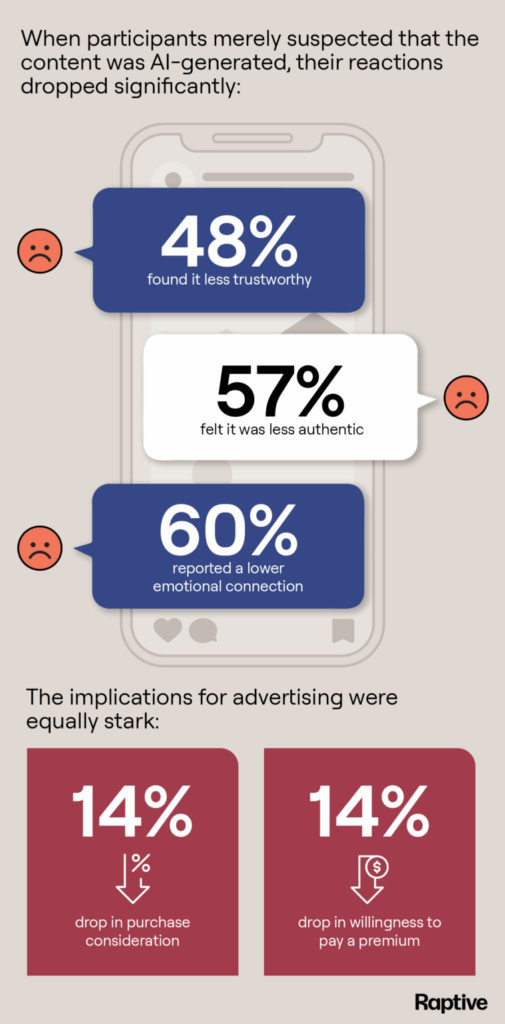
Quality still decides your return on investment. (Raptive’s study from below found that AI-generated ad copy led to a 14% drop in purchase consideration.)
Human-in-the-loop editing
If you prioritize quality, no AI content can go out the door untouched.
Audiences want to feel a pulse when they read content.
Someone needs to edit, fact-check, rewrite, re-prompt, clean up the tone, and make sure the copy sounds on-brand. This human time is one of the greatest costs. But it’s one you can’t skimp on.
In fact, websites that try to scale AI content production without human oversight can get penalized by Google.
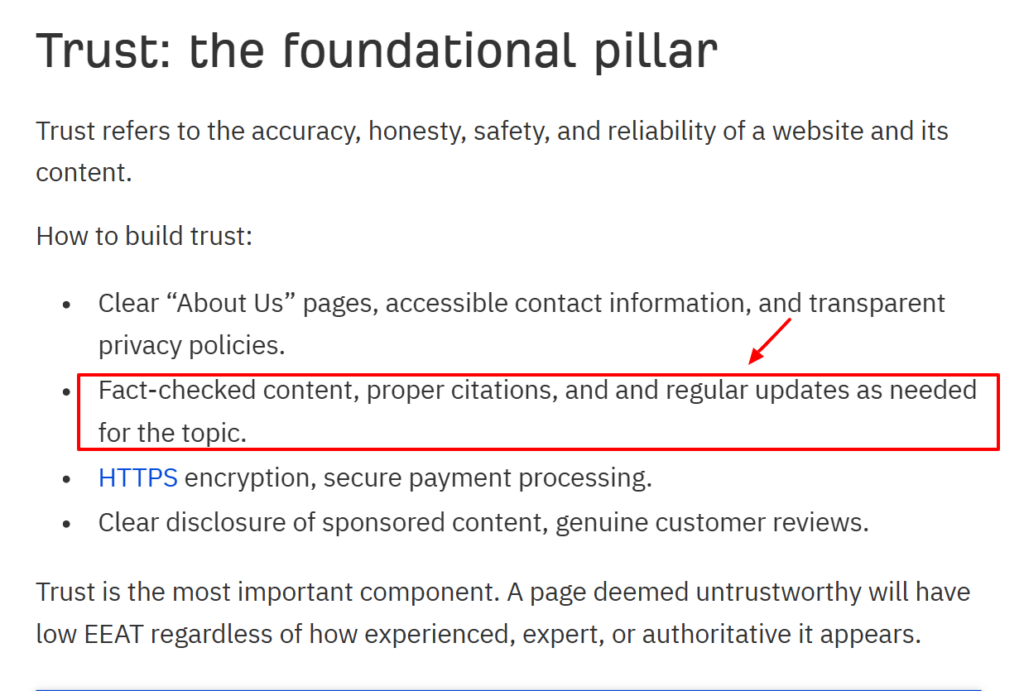
But even worse, AI content bruises the target audience’s trust. According to a study by Raptive, 48% of participants trusted content less even if they simply suspected it was AI-generated.
Costs of non-AI-assisted content creation
If you were to fully rely on human content creation, the line items are simpler. But you’d have to pull data to learn what’s working manually.
Content production processes will also look different when effort is limited to humans.
If you run a small agency, you could get by with a few simple tools, like Google Docs, Google Analytics, and Gmail. But if you have a bigger agency, you may need AI-assisted workflows and platforms to stay organized. Otherwise, you could lose track of campaigns.
That said, here are some ROI markers and costs of non-AI-assisted content creation:
Human labor for content production
Every piece of content (blogs, social posts, ad creatives, emails) comes from human hours. Writers, editors, designers, and strategists all need time to research, draft, revise, and polish content.
Human workflow overhead
Even without AI, you still need project managers, content calendars, approvals, and campaign coordination.
Setting up and maintaining these processes takes people.This can often mean several full-time employees or long-term freelancers, which slows scaling compared with AI-assisted workflows.
Research and data prep
AI can spot patterns at scale, but humans bring context and judgment that AI might miss. Still, humans need organized inputs too. Gathering customer insights and analyzing past campaigns takes dedicated hours.
Quality control and compliance
You can’t skip legal or fact-checking reviews. Hallucinations are less of an AI issue here, but mistakes still happen — and correcting them requires oversight from editors.
Ongoing content refresh and optimization
Even human-written content needs updating. Brand voice evolves, facts change, and campaigns need tweaking to stay effective. Maintaining evergreen content across channels adds recurring costs.
Testing ads and marketing performance
Producing content is only part of the investment. A/B testing (Facebook ads or Google ads) is important. Plus you still need to optimize and analyze human-generated campaigns for conversions and ROI.
If you need help comparing your own costs, see our checklist below. 👇
How to track content product costs: AI assisted versus non-AI-assisted (a helpful checklist)
Use this checklist to uncover your AI-assisted versus non-AI-assisted content ROI:
- List all content types (blogs, social posts, ad copy, emails, graphics, videos). Identify which pieces are AI-assisted and which are fully human.
- Track AI tool costs: Subscriptions, token usage, API fees, AI editors, image generators, and workflow apps.
- Log human-in-the-loop hours: Time spent editing, fact-checking, rewriting, polishing AI-generated content. Multiply by fully loaded hourly rates (salary + benefits).
- Factor in operational overhead: CMS/CRM integration, social scheduling, analytics dashboards, and workflow maintenance.
- Include data prep & cleanup: Organizing research, product info, CRM data, or any inputs for personalization. Consider security and vulnerability scanning if using AI-powered tools.
- Track quality control & compliance: Legal review, copyright checks, brand safety oversight. Applies to both AI-assisted and human-generated content.
- Account for content refresh: Updating facts, adjusting brand voice, and keeping evergreen content relevant. For AI content, also update prompts or workflows.
- Calculate human-only labor costs: Hours for writing, editing, designing, and strategizing fully human content. Multiply by fully loaded rates.
- Measure marketing performance: Track click-through rates, conversions, revenue per page, and campaign ROI. Compare AI-assisted and human-generated content performance.
- Sum total costs per content type: Combine AI tools, human labor, operational overhead, and data prep costs. Don’t forget to factor in the price of campaign funnels. (Cost to create landing pages, Google Ads fees, checkout software costs, etc.)
- Calculate ROI: Have revenue tracking in place. Divide revenue or impact by total cost per content type. See which content types and workflows deliver the best conversion rates.
Wrap up
Revenue tracking is one of your most important jobs as a marketer. You’re creating campaigns across multiple marketing channels and have clients that depend on your results. Not to mention, you have your own company’s budget to think about.
Your best bet is to track your ROI on AI-assisted processes versus fully human processes to see which approach delivers the best return on your time, effort, and budget.
Read through our lists again and use our handy checklist to get the answers you’re looking for.
And if you need a way to track your marketing expenses, try Akaunting. It’s free to start!
Author bio