
Why Customer Statements Matter More Than You Think
Reading Time: 4 minutesLate payments don’t always occur because customers refuse to pay. Sometimes, they happen because records are unclear, balances are misunderstood, or it’s difficult to track past payments. That’s why customer statements are important.
A customer statement provides both you and your customer with a clearer view of account activity in one place. Instead of having to move between invoices, payment records, and customer notes, you get a single report that shows what was billed, what was paid, and what is still outstanding.
Akaunting’s Customer Statement app is designed for this purpose. It allows businesses to see all transactions with a customer, including account summaries, transaction history, and downloadable or shareable statements.
What is a customer statement?
A customer statement is a summary of a customer’s financial activity with your business over a given period. It can include opening balance, invoiced amount, payments made, available credit, transaction dates, document types, payment status, and running balance.
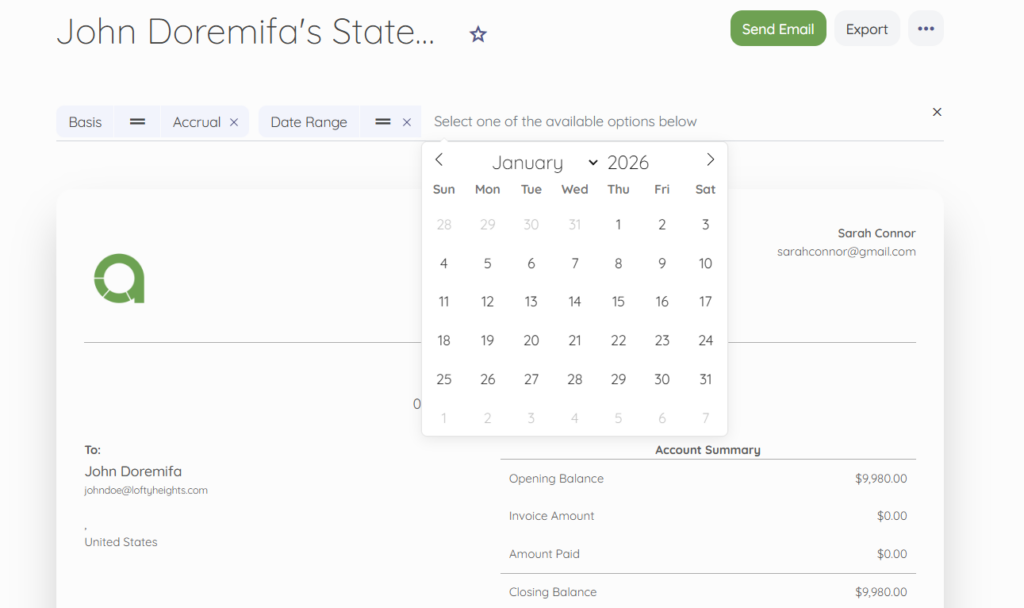
In Akaunting, the Customer Statement app also displays saved customer details such as name, email, and office address.
In simple terms, it helps answer the questions customers ask most:
- – How much do I owe?
- – What have I already paid?
- – Which invoices are still open?
- – What does my account history look like?
That kind of visibility matters more than most businesses realize.
Why small businesses should care about customer statements
Small businesses often lack the time to pursue lengthy payment disputes or conduct manual record checks. When a customer seeks clarification, quick answers are essential.
A customer statement simplifies this process by providing a comprehensive view of the account. Akaunting’s Customer Statement app includes an account summary section that shows the opening balance, invoiced amount, amount paid, and available credit, along with a transaction history that can be filtered by date range.
It also displays payment status and balance across transactions, making it easier to identify who pays on time and which accounts may require follow-up. This approach offers three immediate benefits.
1. It reduces confusion
When customers can clearly see their invoices, payments, and balances, there is less room for misunderstanding.
2. It improves follow-up
A cleaner account history makes it easier for your team to know when to send reminders, resend invoices, or escalate overdue balances.
3. It supports better decision-making
Statements do not just help with collections. Akaunting specifically positions them as useful for in-house audits and for identifying loyal or high-spending customers based on statement activity.
Check out: Net 30 payment terms for customers
What you can see in Akaunting’s Customer Statement app
The app is designed to make customer account tracking more practical and less complicated.
With it, you can:
- – Track sent invoices
- – See the invoice payments by the customer
- – Get a summary of customer transactions
- – View transaction history
- – Categorize transaction documents
- – Send customer statements by email
- – Print or download statements as needed
That means the statement is not just a static report. It becomes a working document your business can use for collections, reviews, support conversations, and internal checks.
Customer statements work best when your invoicing is already organized
A statement is only as useful as the records behind it. That is why invoicing and statement management should work together.
Akaunting’s invoicing is built to help businesses create and send unlimited invoices, automate payment reminders, track cash inflow, and simplify receivables tracking. It also supports recurring invoices, multiple currencies, taxes, discounts, and payment reminders for due invoices.
Statements become even more useful when paired with reconciliation
One of the easiest ways to keep customer records accurate is to ensure your invoice and payment data are linked to actual bank activity.
Akaunting’s Bank Feeds app lets users auto-sync bank records, view transactions on one dashboard, and reconcile accounts payable and receivable. Its documentation also explains that synced bank transactions can be reconciled by creating invoices or bills and linking transactions to them.
Better reconciliation leads to more reliable customer statements.
Check out: how to reconcile transactions on Akaunting
When should you send a customer statement?
You do not have to wait for a payment problem before sending one.
Customer statements are useful when:
- – A customer asks for a full account summary
- – You want to follow up on overdue balances
- – You are preparing for the month-end review
- – You want to help customers verify recent payments
- – Your finance team needs cleaner records for internal checks
Akaunting allows statements to be printed, downloaded as PDFs, or emailed, making them easy to share when needed.
Final thoughts
Customer statements are one of those tools that seem simple until you need them. Then they become essential. They help you answer payment questions faster, keep customer records clearer, support internal audits, and make follow-ups less stressful.
Akaunting’s Customer Statement app brings all of that together in one place, showing account summaries, transaction history, payment status, and shareable statements for each customer.
Want a simpler way to keep customer balances, payments, and account history organized? The Customer Statement app can help you make every customer account easier to review, share, and act on.