
June 2026 Round Up: Product Improvements, User Growth, Feature Trends
Reading Time: 6 minutesJune brought several important developments across the Akaunting community.
Alongside new product improvements, users became more active in expense management, customer relationship management, estimates, recurring invoices, and inventory setup. There was also growing interest in workforce management, data control, backups, custom fields, and bank transaction imports.
This June 2026 round-up explores what changed, which regions recorded the strongest growth, and what the latest activity may suggest about the accounting needs of small businesses.
What Changed in the Latest Akaunting Update?
The latest Akaunting update focuses on three important areas: better organization, broader accessibility, and greater financial accuracy.
Businesses can now organize customers and vendors more effectively, making it easier to manage contacts according to their roles, relationships, or internal structure.
The update also improves the experience for businesses that use right-to-left languages. This is particularly important for users who work in languages such as Arabic, Persian, and Hebrew, where interface direction can directly affect readability and usability.
Akaunting has also strengthened the accuracy of:
- – Bills
- – Payments
- – Banking transactions
- – Financial reports
These improvements matter because small inconsistencies can spread across an accounting system. A payment recorded incorrectly, for example, may affect an outstanding bill, a bank balance, and the reports used to make business decisions.
Improving the connection between transactions and reports helps businesses work with financial data they can trust.
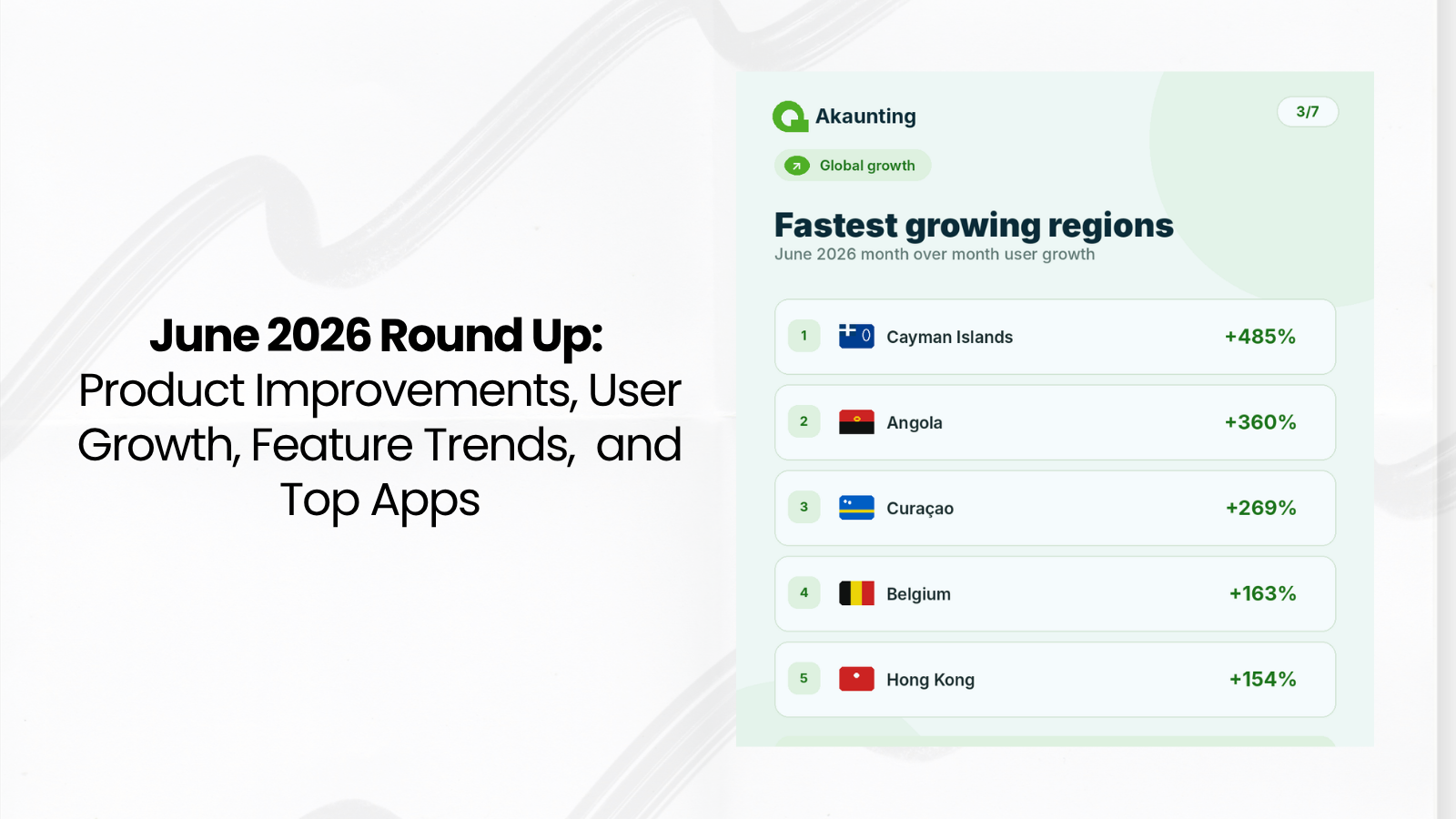
June 2026 User Growth by Country
Akaunting recorded strong month-over-month user growth in several regions during June.
| Country or Region | Month over Month Growth |
| Cayman Islands | +485% |
| Angola | +360% |
| Curaçao | +269% |
| Belgium | +163% |
| Hong Kong | +154% |
Uzbekistan, Senegal, and Uganda also recorded notable increases in user activity.
These percentages measure growth compared to May 2026. They do not necessarily mean that these countries have the largest total number of Akaunting users.
What Regional Growth May Tell Us
The June results show growth across Africa, Europe, Asia, the Caribbean, and Central Asia.
This geographic diversity suggests that the need for accessible accounting software is not limited to one type of economy or business environment.
Small businesses in different regions may have different tax, payment, reporting, and compliance requirements. However, they often share similar operational challenges:
- – Organizing customers and vendors
- – Sending invoices and estimates
- – Tracking expenses
- – Managing recurring payments
- – Importing banking transactions
- – Understanding financial reports
The growth across multiple markets may therefore reflect broader demand for flexible accounting software that supports different currencies, languages, business structures, and workflows.
Most Used Akaunting Features in June 2026
The fastest-growing user activities in June were concentrated around expenses, customer management, estimates, recurring billing, and product creation.
| Akaunting Feature | Growth | Popular Countries |
| Send Expense Transaction | +77% | Mozambique, Bangladesh |
| Create CRM Contact | +60% | Hong Kong, Morocco |
| Create Estimate | +47% | Kenya, Fiji |
| Create Recurring Invoice | +17% | Panama, United Kingdom |
| Create Item | +8.4% | Hong Kong, Philippines |
Each of these activities reflects a different stage of business management.
Send Expense Transaction Increased by 77%
Send Expense Transaction recorded the strongest feature growth in June, increasing by 77%. The feature was particularly popular in Mozambique and Bangladesh.
This increase suggests that more users were actively processing, sharing, or managing expense-related transactions inside Akaunting.
Expense management is a fundamental part of bookkeeping because expenses affect:
- – Cash flow
- – Profitability
- – Tax preparation
- – Supplier records
- – Business budgets
- – Financial reporting
When expenses are recorded consistently, businesses gain a more realistic view of how much they spend and where their money goes. The growth also indicates that users are moving away from informal expense-tracking methods such as spreadsheets, paper receipts, and messaging apps.
Create CRM Contact Increased by 60%
The CRM Contact activity grew by 60%, with notable usage in Hong Kong and Morocco.
This suggests that more businesses are integrating their accounting workflows with customer relationship management systems.
CRM contacts can help businesses organize information about: Customers, Leads, Vendors, Partners, Sales opportunities, and Previous interactions.
For a small business, accounting and customer management are closely connected.
An estimate may become an invoice. An invoice may lead to a payment reminder. A customer may require repeat billing or additional services.
Keeping customer information inside a structured CRM helps businesses maintain context throughout this process. The increase in CRM contact creation may also reflect the latest Akaunting improvements that make it easier to organize customers and vendors.
Create Estimate Increased by 47%
Estimate creation increased by 47%, with strong activity in Kenya and Fiji.
Estimates are often used before an invoice is created. They allow a business to explain expected prices, services, quantities, or project costs before the customer commits.
A clear estimate can help businesses:
- – Set customer expectations
- – Reduce pricing misunderstandings
- – Define the scope of work
- – Improve approval processes
- – Convert accepted work into invoices more efficiently
This is particularly useful for contractors, consultants, agencies, service providers, and businesses that offer customized pricing.
Create Recurring Invoice Increased by 17%
Recurring invoice creation grew by 17%, with notable usage in Panama and the United Kingdom.
Although the increase is smaller than for some other features, it remains important because recurring invoices are closely associated with predictable revenue.
Businesses may use recurring invoices for: Monthly retainers, Subscription services, Memberships, Maintenance agreements, Rent, Hosting services, and Regular consulting work.
Automating these invoices reduces repetitive work and the risk of a business forgetting to bill a customer. Recurring invoices can also support better cash flow planning by providing the business with a clearer view of expected revenue.
Create Item Increased by 8.4%
The Create Item feature grew by 8.4%, with strong activity in Hong Kong and the Philippines.
Items help businesses standardize the products and services they add to invoices, bills, estimates, and other financial documents.
Instead of entering the same information repeatedly, a business can save: Product names, Service descriptions, Prices, Tax information, Units, and Inventory details.
The increase suggests that more users were building structured product or service records.
Although 8.4% is a more moderate increase, it represents steady adoption of a foundational accounting workflow rather than a short-term spike.
Create Category Dropped by 73%
The biggest decline in user activity during June was in Create Category, which fell by 73% compared to May. This decline should be interpreted within the context of previous activity.
In May, the Create Category increased by 119%. The sharp June decline may therefore represent a return to a more normal level after an unusually active month.
Category creation is also typically a setup-based activity.
Businesses may create categories when they:
- – Open a new Akaunting account
- – Restructure their bookkeeping
- – Add new income sources
- – Introduce new expense types
- – Prepare for more detailed reporting
Once the necessary categories have been created, users do not need to repeat the action every day.
The decline does not necessarily mean businesses stopped using categories. It may simply mean that many users completed their initial setup in May and spent June using the categories they had already created.
Top Akaunting Apps and Subscriptions in June
The most purchased Akaunting apps and subscriptions by month-over-month growth were:
| App or Subscription | Growth |
| Leaves | +200% |
| Elite On Premise | +100% |
| Backup & Restore | +33% |
These results point to growing interest in employee management, data control, and business continuity.
Leaves Purchases Increased by 200%
The Leaves app recorded the strongest purchase growth, increasing by 200%. This suggests that more businesses are looking for structured ways to manage employee leave.
Leave management becomes increasingly important as a business adds employees. Informal systems may work for very small teams, but they can become difficult to maintain as the organization grows.
A leave management process can help businesses track: Annual leave, Sick leave, leave balances, Approval requests, Employee availability, and Upcoming absences.
Elite On-Premise Purchases Increased by 100%
Elite on-premise purchases increased by 100%. On-premises accounting solutions appeal to businesses that want greater control over how and where their financial data is hosted.
This may be important for organizations with specific requirements related to: Data ownership, Internal infrastructure, Security policies, Custom configurations, Regulatory obligations, or System integrations.
The increase suggests that more users are evaluating Akaunting as part of a more controlled or customized technology environment.
Backup & Restore Purchases Increased by 33%
Backup & Restore purchases increased by 33%. Backups are an important part of financial data management because accounting records are critical business assets.
The increase in purchases suggests that more businesses are thinking beyond daily accounting tasks and paying attention to business continuity.
Biggest Growth in Added to Cart
The apps and subscriptions with the largest growth in added to cart activity were:
| App or Subscription | Added to Cart Growth |
| Elite On Premise | +150% |
| Custom Fields | +100% |
| OFX | +80% |
It shows which products users are considering, but it does not confirm that every user completed the transaction. This makes it a useful indicator of interest and purchase intent rather than final revenue.
- — The presence of Elite On Premise in both categories suggests that interest was not limited to casual product browsing. A meaningful number of users also moved forward with a purchase.
- — Interest in Custom Fields suggests that users want accounting software that can adapt to their processes rather than forcing every business into the same structure.
- — OFX is a financial data format used by many banks and financial institutions to exchange transaction information. The increase in interest suggests that users are looking for more efficient ways to connect banking activity with their accounting workflows.
Tip of the Month: Save Customer Payment Details With FluidPay
Akaunting users can securely save customer card and ACH details using FluidPay.
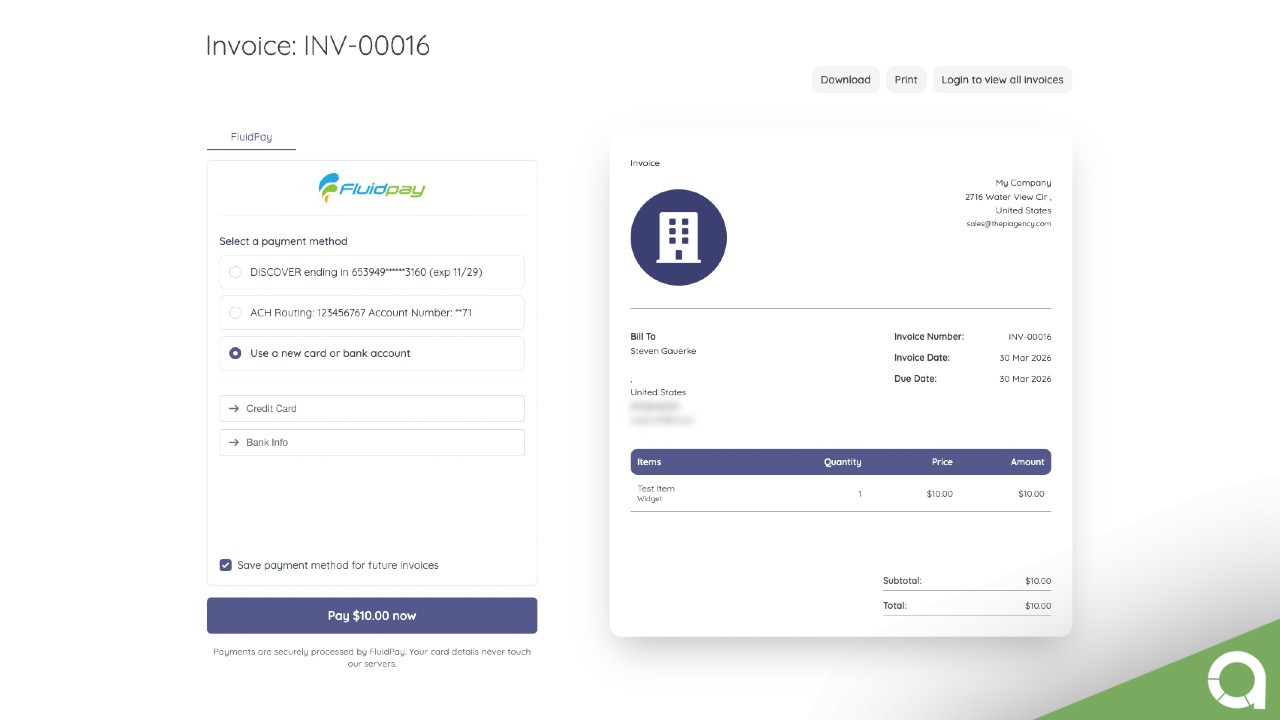
This can speed up future invoice payments because returning customers do not need to re-enter the same payment information each time.
Instead, future payments may be completed with a simpler, one-click process. For businesses, reducing the number of steps required to pay an invoice can help improve the payment experience.
Recommended Accounting and Business Reads
- AI Accounting Assistant for Small Businesses | Akaunting x ChatGPT App
- Vendor Onboarding Process: A Risk Tiering Framework
- Best Practices in B2B Credit Risk Management (2026)
- Cap Table Basics Every Startup Founder Needs to Understand
- Akaunting May 2026 Round Up: AI Accounting, Invoicing Trends