
March 2026 Round Up: Amazon Seller Bookkeeping, User Growth, and Top App Trends
Reading Time: 5 minutesMarch gave us another useful look at how small businesses are using Akaunting in real life. From rising user activity across multiple regions to stronger interest in workflow-focused apps, this month’s trends point to one clear theme: businesses want better structure as they grow.
That is especially true for online sellers. According to Amazon, more than 60% of its sales come from independent sellers, most of which are small- and medium-sized businesses. That matters because as order volume rises, financial admin rises with it. More sales usually mean more invoices, more transaction records, more reconciliation work, and more room for bookkeeping errors if everything is handled manually.
This is where Akaunting’s Amazon app becomes especially useful. It is designed to import invoices and transactions from Amazon Business into Akaunting, helping users keep records cleaner and easier to track as sales activity grows.
Top growth regions in March
Here are the regions that grew the most in March compared to February:
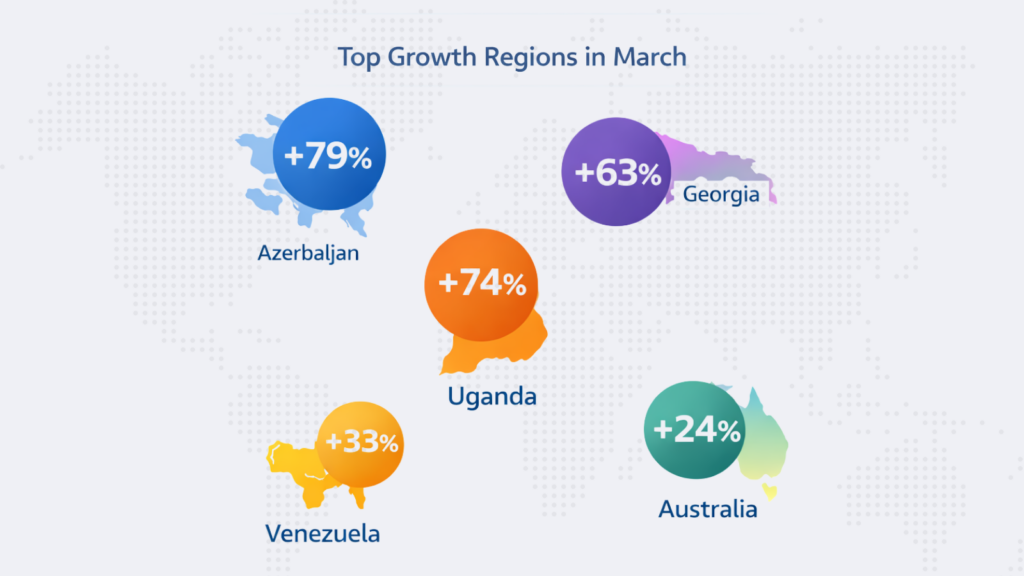
Notable mentions also go to El Salvador, Serbia, Trinidad & Tobago, and Greece.
What makes this month’s regional spread interesting is that growth is not coming from one single block of markets. It is across different business environments, suggesting a broader demand for accessible accounting tools that reduce complexity for small teams.
What users did more in March
Compared to February, here is what users did most in March:
Print Invoices: +50% (Popular in Singapore and France)
A 50% increase in invoice printing suggests that many users are still working in environments where shareable, downloadable, or physically presented billing documents matter. That often points to more formal billing processes, stronger documentation habits, or businesses serving customers who still prefer traditional invoice workflows.
Watch App Demo Videos: +44% (Popular in Myanmar and the United States)
It suggests users are actively exploring Akaunting’s broader capabilities rather than staying limited to basic workflows. In many SaaS products, that kind of behavior points to rising product adoption, feature discovery, and expansion intent.
Other Activities
Adding new vendors increased by 23%, led by Brazil and El Salvador, while adding new customers rose 15%, with the United States and Bangladesh standing out. Taken together, those two numbers tell a simple story: users are expanding their business networks. More vendors mean more purchasing relationships to manage. More customers mean more invoices, more follow-ups, and more financial activity to track properly.
Notification views also rose by 20%, particularly in the United States and South Africa. That may sound small, but it usually reflects something useful. Businesses are paying attention. When users stay up to date with alerts, reminders, and account activity, it becomes easier to catch issues early rather than deal with them after they become bigger problems.
The biggest drop in activity
One notable drop did appear in the data. Create Roles fell by 44% compared to February. That is not necessarily negative. Role creation often spikes during setup periods, restructuring, or team expansion. A decline can simply mean fewer users were configuring permissions in March and more were focused on everyday work.
Top purchased apps and subscriptions
The most purchased apps and subscriptions in March were:
- – Point of Sale: +200%
- – Credit/Debit Notes: +57%
- – Elite Cloud: +50%
The growth of the Point of Sale app suggests a stronger interest in faster sales handling and better transaction capture. It is a way to process sales, track inventory levels, and gain insights into purchase demand, which makes it especially relevant for retail and other high-transaction businesses.
The rise in Credit/Debit Notes points to a need for cleaner adjustment workflows. The app is built to help businesses create and track credit and debit notes, manage refunds and vendor-related corrections, and reduce bad debt by maintaining more transparent records. That kind of demand usually grows when businesses want tighter control over exceptions, returns, and billing changes.
Elite Cloud’s growth also makes sense in this context. Elite Cloud is a hosted plan for mid-sized businesses, with higher limits for companies, users, invoices, and included apps than smaller plans. That suggests some users are moving beyond lightweight use to a stage where scale, access, and broader functionality matter more.
Biggest growth in added to cart
The apps with the biggest added-to-cart growth in March were:
- – Backup & Restore: +450%
- – Custom Fields: +125%
- – Stripe: +80%
This part of the data is useful because added-to-cart behavior often reveals purchase intent before conversion.
The sharp increase in Backup & Restore suggests users are thinking more seriously about data protection and continuity. The app can automatically or manually back up invoices, items, bills, settings, and other financial data, then restore them with one click. For any business that relies heavily on accounting records, that kind of safety becomes increasingly important as activity grows.
Interest in Custom Fields suggests users want more flexibility in how they structure data. The app allows businesses to add tailored fields across invoices, customers, vendors, transfers, and more, which is exactly the kind of customization growing businesses often need when off-the-shelf defaults stop being enough.
The rise in Stripe points to a familiar priority: getting paid faster with less friction. The app lets customers pay invoices online and automatically syncs payments to invoices, making it useful for businesses looking to reduce manual payment tracking and improve cash collection speed.
March offer
Users can save 50% on the top added-to-cart items with the code 50APRIL2026 at checkout. The discount applies to the listed apps.
Tip of the month: reduce vendor back and forth
A simple way to reduce payment confusion is to make vendor records easier to review and share.
With the Vendor Statement app, users can generate and send statements showing bills, payments, and closing balances for a selected period. It is a faster way to keep vendor payment records organized and communicate account activity clearly. That matters because when vendors can see what happened and what remains outstanding, businesses spend less time explaining transactions.
Final thoughts
March’s numbers point to something bigger than feature popularity. They show users building stronger financial processes around growth. They are selling across platforms like Amazon, adding new vendors and customers, exploring new app capabilities, and leveraging tools that improve payment processing, documentation, flexibility, and record protection.
The pattern is clear: small businesses do not just want accounting software. They want systems that help them stay accurate while moving faster. That is what this month’s trends reflect.
Recommended reads
To keep exploring related topics, link to these articles internally:
- – Accounting for the Algorithm: Tracking ROI on AI-Powered Content Creation vs. Custom Development Costs
- – Making Tax Digital for Income Tax: The Simple 2026 Guide for Sole Traders and Landlords
- – You Made $10K on TikTok—Now What? A Beginner’s Guide to Managing Creator Income
- – Accounting Basics for Content Creators: Setting Up Clean Books From Day One
- – Akaunting February 2026 Round Up: Customer Statements, and Growing Trends